factory quality control is a practical sourcing and product-development consideration for B2B buyers evaluating smart hardware programs. This guide explains the technical, commercial and manufacturing factors buyers should assess before committing to samples, tooling or mass production.
Why Factory Quality Control Is Non-Negotiable in B2B Sourcing
For B2B buyers in smart hardware, consumer electronics, and industrial components, factory inspection process separates scalable supply chains from costly liabilities. A single undetected defect can cascade into warranty claims, retail chargebacks, or a full product recall. Buyers evaluating suppliers should treat documented QC capability as a core vendor qualification criterion, not an optional add-on.
The True Cost of Skipping Quality Checks
Skipping structured checks shifts risk downstream. Rework at a distribution center costs multiples of correction at the production line, and field failures erode buyer trust permanently. For OEM and ODM partners, missed defects also delay firmware or tooling iterations. A disciplined factory audit report review before order placement is often the cheapest insurance a sourcing team can buy.
How Quality Control Impacts OEM, ODM, and Private Label Success
OEM buyers need dimensional and functional consistency to protect their own brand specifications. ODM buyers depend on the factory’s internal QC during production to catch deviations before they become embedded in the design. Private label importers carry the highest exposure, because the factory name never reaches the end customer; every defect is attributed to the buyer’s label. Consistent QC during production therefore directly supports repeat orders, lower total landed cost, and safer scaling across product lines.
Pre-Sourcing Audit: Evaluating Factory Capabilities Before You Commit
Before placing a purchase order, a pre-sourcing audit reveals whether a supplier can actually meet your technical and volume requirements. This stage of pre-shipment inspection is not about inspecting finished goods; it is about verifying systems, equipment, and management competence before money changes hands. For OEM and private-label buyers, skipping this step often converts a low unit price into hidden costs: rework, delays, or a failed launch.
Certifications and Compliance Checks
Request current certificates and verify them against issuing bodies such as ISO directly rather than accepting scanned copies. Match the certificate scope to your product category: an ISO 9001 certificate for plastic injection does not cover PCB assembly. For ODM projects, confirm the factory holds relevant safety marks for your target market. Ask who performed the last third-party audit and read the report; unresolved major non-conformities should disqualify a candidate.
Production Capacity and Technology Assessment
Capacity claims need evidence. Ask for machine lists, shift schedules, and current utilization rates, then compare them against your projected order volume plus a 20–30% buffer. Walk the floor to check whether equipment matches the list and whether maintenance logs exist. For private-label electronics, confirm in-house SMT lines, testing fixtures, and firmware flashing capability. A factory running at 95% utilization cannot absorb your peak season without subcontracting, which weakens your quality control checklist leverage.
In-Process Quality Control: Monitoring Production in Real Time
quality control checklist during production catches defects before they compound into costly rework or field failures. For smart hardware, this means verifying solder joints, firmware flashes, sensor calibration, and connector seating while lines are still running. Buyers should ask OEM/ODM partners to define control points at each station where a defect can be introduced, not just at final assembly.
Key Inspection Points During Manufacturing
Your quality control checklist should cover first-article approval, hourly dimensional checks, functional testing after firmware load, and torque or pull tests on mechanical joints. For private-label products, confirm that the factory inspects your specific SKU variants, not a generic reference unit. A strong factory inspection process includes documented stop-line authority when a station exceeds its defect threshold.
Using Data and IoT for Real-Time Quality Tracking
Modern lines can stream test results, cycle times, and rejection reasons to dashboards you can monitor remotely. Ask whether the factory logs serial-level traceability and whether that data survives a line changeover. This matters for warranty analysis and for comparing suppliers. For guidance on evaluating what a factory claims versus what it documents, see how to read a factory audit report. Real-time visibility reduces the burden on pre-shipment inspection by resolving issues earlier.
Pre-Shipment Inspection: The Final Gate Before Your Product Leaves the Factory
Pre-shipment inspection is the last opportunity to catch defects before goods are packed, sealed, and shipped. For OEM/ODM buyers, this check confirms that production units match the approved golden sample and that packaging, labeling, and firmware versions are correct. Private-label importers should treat this as a contractual release point: do not authorize final payment until the inspection report is reviewed and accepted.
AQL Sampling and Defect Classification
Use ANSI/ASQ Z1.4 or ISO 2859-1 sampling plans rather than arbitrary percentages. A common starting point is General Inspection Level II with AQL 2.5 for major defects and AQL 4.0 for minor defects. Critical defects—safety hazards, missing regulatory marks, incorrect voltage ratings—should have an AQL of 0 and trigger automatic rejection. Ask the inspector to photograph every defect and classify it as critical, major, or minor on the quality control checklist.
Functional Testing for Smart Devices and Peripherals
Beyond visual checks, specify powered functional tests on the sampled units. For smart devices, verify pairing, firmware version, sensor response, and battery charge retention. For peripherals, test connector fit, button actuation force, and cable strain relief. If your product relies on companion apps, confirm the sampled units connect to the current app build. Document pass/fail criteria in the factory inspection process so results are repeatable across batches and inspectors.
Quality Control for OEM, ODM, and Private Label: Tailoring Checks to Your Model
Your sourcing model determines which factory inspection process failures carry the highest risk. An OEM buyer owns the design and must guard tolerances and IP. An ODM buyer inherits the supplier’s platform but needs verification that claimed specs are real. A private-label buyer depends on repeatable batch consistency. Align your quality control checklist with the model before production begins.
OEM: Ensuring Spec Compliance and IP Protection
For OEM programs, your drawings and BOM are the contract. During QC during production, verify that components match approved samples and that no unapproved substitutions appear. Ask inspectors to photograph mold markings, PCB revisions, and firmware identifiers. Confirm that rejected units are destroyed on-site, not resold. Reviewing a factory audit report before onboarding helps confirm the supplier’s document control and confidentiality practices are adequate for your IP.
ODM: Verifying Design Integrity and Customization
ODM buyers should treat the supplier’s datasheet as a claim, not a guarantee. Your factory inspection process must test the exact performance parameters you market: battery runtime, waterproof rating, output torque, or wireless range. Request golden samples and lock them as reference standards. When customization touches housings, labels, or firmware, inspect those elements early in the first production run to catch tooling or configuration drift before volume builds.
Private Label: Maintaining Brand Consistency Across Batches
Private-label sourcing shifts risk to batch-to-batch variation. A pre-shipment inspection should compare current production against retained samples from the previous order, not just against a generic standard. Check color, surface finish, packaging, and accessory contents. If the supplier sources components from multiple sub-vendors, ask for incoming material records. Consistent documentation across orders gives you leverage when a batch deviates and protects your brand’s shelf reputation.
Risk Mitigation: Handling Quality Failures and Supplier Non-Compliance
Root Cause Analysis and Corrective Action Plans
When a defect appears during QC during production or pre-shipment inspection, stop and demand a formal root cause analysis before accepting any rework. Require the supplier to identify whether the failure came from raw material variance, tooling wear, operator error, or process drift. A credible corrective action plan names the specific process step, assigns an owner, and sets a verification date. For OEM and ODM buyers, ask whether the fix changes the bill of materials or firmware—if so, request updated documentation and a new sample approval. Private-label importers should confirm that reworked units meet the same packaging and labeling specs as the original run.
Building a Contingency Plan for Supply Chain Disruptions
No factory inspection process eliminates every risk, so predefine escalation triggers and backup options. Set thresholds for rejection rates, late corrective actions, or repeat non-conformities that automatically trigger a second audit or a hold on payments. Maintain at least one qualified alternate supplier for critical components or finished assemblies, even if you only use them for overflow. Review your quality control checklist to confirm that contingency suppliers follow the same inspection gates.
For ODM relationships, secure access to tooling ownership and design files in the contract so you can move production without losing months of development. Document all non-compliance events with photos and dated reports—this evidence strengthens warranty claims and future negotiations.Decision Criteria: Choosing a Factory That Prioritizes Quality
After running the checks described earlier, you need a repeatable way to compare candidates. A scorecard converts subjective impressions into weighted, defensible scores. Without one, buyers tend to over-weight price or a single impressive visit and under-weight systemic quality control checklist signals.
Scorecard for Factory Evaluation
Assign weights to five areas: documented QC process (25%), equipment and calibration records (20%), staff training and retention (20%), defect and CAPA history (20%), and communication responsiveness (15%). Score each factory 1–5 per area, then multiply by weight. For OEM projects, add a 10% engineering-change-management factor and reduce the communication weight. For ODM, weight design documentation and component traceability higher. For private-label runs, emphasize line-changeover controls and packaging inspection. Require evidence for every score: audit reports, calibration logs, or sample inspection records. A factory that cannot produce these documents scores zero, regardless of verbal assurances.
Red Flags to Avoid in Factory Partnerships
Treat any of the following as disqualifying: refusal to allow a third-party audit, inconsistent batch records, high staff turnover in QC roles, or quotes that undercut realistic material costs. Also watch for factories that push back on pre-shipment inspection or offer to “fix” issues only after payment. If a supplier claims ISO certification but cannot show the certificate or audit scope, verify through the certification body. When comparing a trading company against a direct factory, confirm who actually performs QC during production and who signs the inspection report.
How Pineeon Embeds Quality Control into Every Smart Hardware Project
OEM/ODM/Private Label Support with Built-In Quality Assurance
Pineeon treats factory inspection process as a design input, not an afterthought. For OEM buyers, incoming component inspection follows an approved vendor list with documented lot traceability. For ODM and private label programs, the quality control checklist is agreed before tooling begins, covering cosmetic standards, functional test parameters, and packaging requirements. Buyers should ask whether the supplier owns the QC plan or merely executes yours — ownership changes accountability. Confirm that engineering change orders trigger re-validation, and request the factory inspection process map before signing. A supplier that cannot show how quality gates map to your product’s bill of materials is likely improvising.
Smart Wearables and Computer Peripherals: Custom Development with QC at Every Stage
Wearables and peripherals fail in predictable ways: sensor drift, connector fatigue, firmware mismatch, battery swelling. Pineeon addresses these through staged controls. During prototyping, design-for-manufacturing reviews flag tolerance risks before tooling. QC during production includes in-line functional testing at defined stations — not just end-of-line sampling — plus environmental stress screening for moisture and temperature on wearables. Pre-shipment inspection then verifies final firmware versions, pairing behavior, and packaging integrity against the approved golden sample.
Buyers evaluating a partner should request sample inspection reports from a recent comparable project and confirm that firmware version control is linked to the inspection record. This is where many suppliers cut corners, and where structured QC prevents field returns.
Pineeon OEM/ODM Manufacturing Context
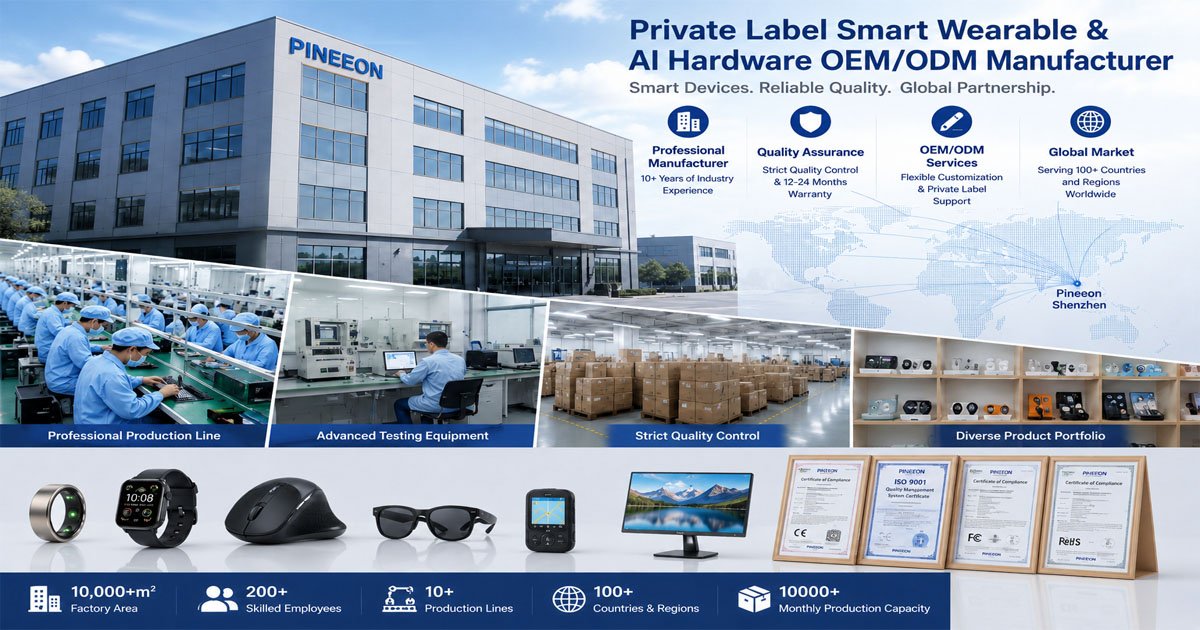
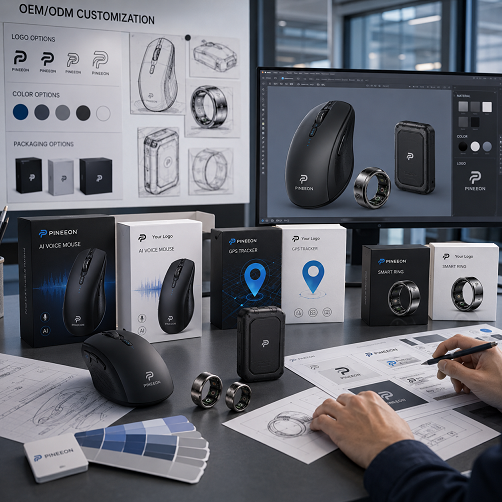
Pineeon is a B2B smart hardware supplier. Pineeon supports OEM, ODM and private label projects, supplies smart wearables and computer peripherals, and supports custom product development for international brands, distributors and sourcing teams.
Frequently Asked Questions
What is the difference between QC and QA in factory sourcing?
Buyers should compare this point with the target specification, market requirements, expected volume, customization scope and approval criteria before production.
How many inspection points should I have for a typical electronics order?
Buyers should compare this point with the target specification, market requirements, expected volume, customization scope and approval criteria before production.
Can I rely on factory-provided quality reports?
Buyers should compare this point with the target specification, market requirements, expected volume, customization scope and approval criteria before production.
What are the most common quality issues in smart wearables and how to prevent them?
Buyers should compare this point with the target specification, market requirements, expected volume, customization scope and approval criteria before production.
QC during production Resources for B2B Buyers
For related Pineeon information, see What's Included in a Factory Quote? Reading Between the Lines. For an external technical or regulatory reference, consult International Trade Administration. These resources help buyers compare specifications, sourcing requirements and product-development decisions.
Factory Quality Control in Smart Hardware Sourcing
For buyers of OEM/ODM smart devices, factory quality control must extend beyond basic visual checks. Pineeon’s private label hardware programs integrate process-level verification so that embedded electronics, firmware flashing, and enclosure assembly meet agreed specifications before shipment.
Incoming Material Verification for Electronics
Smart hardware depends on PCBA, sensors, batteries, and connectors. A practical factory quality control step is verifying lot traceability and moisture-sensitive component handling at incoming inspection. This reduces latent failures that appear only after end-user deployment.
Functional Testing at Subassembly Stage
Rather than waiting for final goods, request functional tests after key subassemblies are built. For Pineeon OEM projects, this can include firmware boot checks, sensor calibration, and wireless module pairing. Catching defects early lowers rework cost and protects your launch timeline.
Packaging and Labeling Audits
Private label buyers often overlook packaging as part of factory quality control. Confirm that barcodes, regulatory marks, and retail carton dimensions are checked against your approved artwork. This prevents costly repacking or customs delays.
Integrating Factory Quality Control Into Your Smart Hardware Sourcing Workflow
For buyers developing OEM, ODM, or private label smart hardware, factory quality control is not a final checkpoint but a continuous discipline. Pineeon’s sourcing model applies these checks at each stage of product realization, from component qualification to pre-shipment inspection, so you can source with fewer surprises and tighter tolerances.
Align QC Gates With Your Product Development Milestones
Define measurable pass/fail criteria at prototype, pilot, and mass production stages. For smart devices, this includes firmware flashing consistency, sensor calibration drift, and enclosure fit. Pineeon helps buyers translate product requirements into factory-level inspection checklists that match ODM or private label specifications.
Use Factory Quality Control Data to Qualify Second Sources
When scaling or diversifying supply, compare incoming quality data across candidate factories using the same inspection protocol. This reduces risk when moving tooling or adding capacity. Pineeon supports buyers in structuring these comparisons for smart hardware categories such as IoT sensors, wearables, and connected home devices.
Document Non-Conformities With Corrective Action Ownership
Every failed check should trigger a documented corrective action request with a named owner and deadline. Without this loop, factory quality control becomes passive reporting. Pineeon’s project coordination includes tracking these actions so that OEM and private label buyers maintain leverage and visibility without being on-site daily.